Article Type: news

The best-selling EVs in China during the first half of 2025

Between January and June, China’s battery-electric vehicle (BEV) market saw domestic competition increase. Meanwhile, the plug-in hybrid (PHEV) sector remained closely contested. Autovista24 special content editor Phil Curry examines the country’s electric vehicle (EV) market with EV Volumes data.

China’s BEV market growth faltered again in June, as it caught up with a strong period of sales in 2024. Overall, 3,498,460 units were delivered in the country during the first half of 2025, a 43.7% year-on-year increase.

However, having peaked at a 50.7% rise in the cumulative figures in April, both May and June saw this figure wane. After exceptional growth in FebruaryMarch and April, improvements were more relaxed in May. June saw an improvement of 39% compared to last year, as 687,277 units were sold in the country.

Meanwhile, the PHEV market returned to an upward growth trend following a wobble in May. The market increased by 36.1% between January and June, with 2,460,588 units taking to Chinese roads.

This was helped by another strong month in June, although the 30.4% monthly increase was the market’s lowest figure since January. Still, the consistent improvements in both BEV and PHEV markets show China’s increasing EV strength.

Geely increases its lead

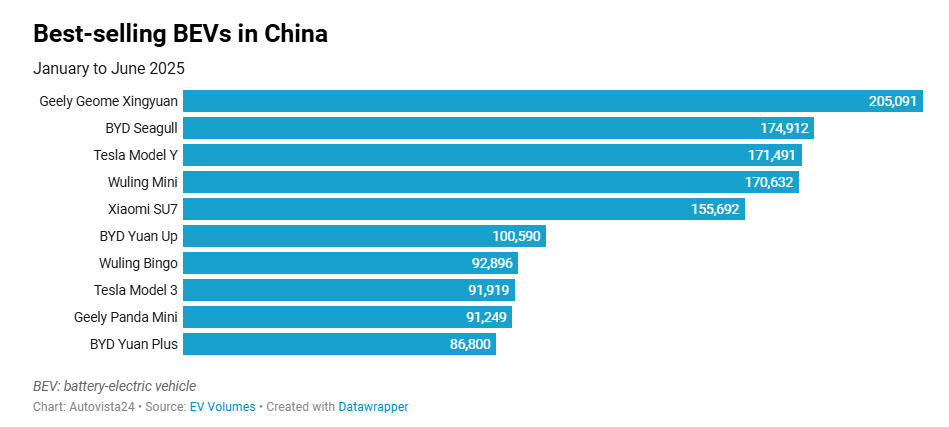
Having reclaimed the top spot in May, the Geely Geome Xingyuan increased its lead in the first half of 2025. The model, which came to the market in September 2024, achieved 205,091 sales between January and June. This meant it made up 5.9% of BEV sales in the country.

June’s outcome created multiple changes in the overall results for the first half of 2025. The BYD Seagull rose to second position, taking a 5% market share with 174,912 units delivered.

This placed it 30,179 behind the Geely model, which has outsold the BYD in five of the six months counted. If the Xingyuan continues its impressive run, it could be difficult to catch.

Tesla’s quarterly delivery boost meant its June results propelled the Model Y into third, from fifth in May. With 171,491 sales, it sits just 3,421 units behind the BYD, taking a 4.9% hold of the market.

The Wuling Mini, which topped the table four months into 2025, slipped back to fourth at the end of June. With 170,632 units delivered, it was just 859 sales behind the Tesla Model Y.

Given the US crossover’s patchy performance in the market in the first half of 2025, the Mini could move up. However, it will need extremely strong results to return to the top of the table.

The fortunes of the BYD, Tesla and Wuling vehicles show the competitive nature of the Chinese market this year. In the first half of 2024, the Tesla Model Y was 50,000 units ahead of the BYD Seagull. This embodied what was a two-horse race 12 months ago. In 2025, the market is more open, with multiple models in the running for the title.

Close competition in China

Fifth went to the Xiaomi SU7 with 155,692 sales. With a 4.5% market share, the model was 14,940 units away from the top four. A further 55,102 units back in sixth was the BYD Yuan Up. It claimed 100,590 deliveries and a 2.9% share of the BEV market in the first six months.

The Wuling Bingo held seventh, with 92,896 units sold and a 2.7% market share. Improving one position to eighth was the Tesla Model 3, benefiting from the brand’s quarterly reporting. It was just 977 units behind the city car, with 91,919 deliveries in total. This gave the BEV a 2.6% market share.

In ninth, the Geely Panda Mini was 670 units behind, having achieved 91,249 deliveries in the first half of 2025. It secured a 2.6% share of the BEV total.

Rounding out the table in 10th was the BYD Yuan Plus, with 86,800 deliveries. Having placed third in the first half of last year, the model has been a victim of increased competition.

Tesla takes the wheel in China

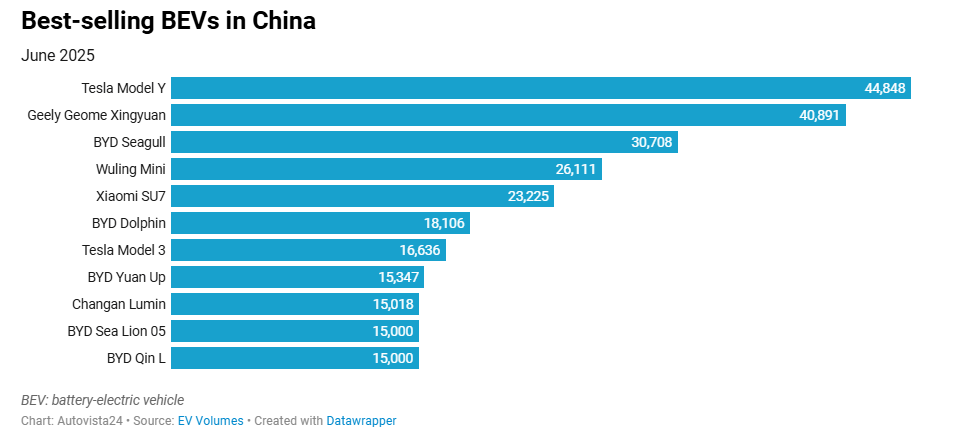
The Tesla Model Y was the best-selling BEV in China during June, thanks partially to the carmaker’s quarterly reporting pattern. It achieved 44,848 deliveries, up 1.7% compared to the same month last year.

This was the model’s best improvement of the year, and only its second across the first six months of 2025. Due to increased competition, its market share fell 2.4 percentage points (pp), to 6.5% in the month.

The Geely Geome Xingyuan continued its impressive performance, with 40,891 deliveries putting it in second. This equated to a 5.9% share of overall deliveries in its 10th month on sale.

The BYD Seagull ended June in third, with 30,708 units taking to Chinese roads. With competition increasing, this was a 12.8% dip compared to last year, while its share of 4.5% was 2.6pp down.

Having struggled in May, the Wuling Mini ended June in fourth and lost further ground to the leading BEV models. It achieved 26,111 deliveries, which was still a 156.3% rise year on year. This also allowed the BEV to grow its market share by 1.7pp, to 3.8%.

Completing the top five was the Xiaomi SU7, with 23,225 units. This was a 62.5% volume increase. It secured a 3.4% hold of the BEV total in the month, up from 2.9%.

BYD on the up

The BYD Dolphin rose to sixth in June with 18,106 deliveries. This was a 114.8% year-on-year improvement, giving the Chinese model a 2.6% market share, up 0.9pp.

Seventh went to the Tesla Model 3, benefiting from the brand’s quarterly reporting. With 16,636 sales, it was 8.3% down on the total achieved in June 2024. This meant its share of the overall BEV total slid from 3.7% to 2.4%.

The BYD Yuan Up took eighth position with 15,347 deliveries, an 82.9% rise. This gave it a 2.2% market share, growing by 0.5pp. In ninth was the Changan Lumin, with its highest monthly sales figure since November 2024. Its 15,018-unit total represented a 70.5% year-on-year improvement, while its 2.2% hold of the market was up 0.4pp.

Two models tied for 10th spot, both of which achieved a record result in their fourth month of sales. This was the BYD Sea Lion 05, making its top 10 debut, and the BYD Qin L. Both recorded 15,000 deliveries in June, equating to a 2.2% share.

Best-selling PHEV declines

There was a sense of status quo in the top four of the PHEV market after six months of 2025. However, the gaps between each ebbed and flowed thanks to each model’s performance in June.

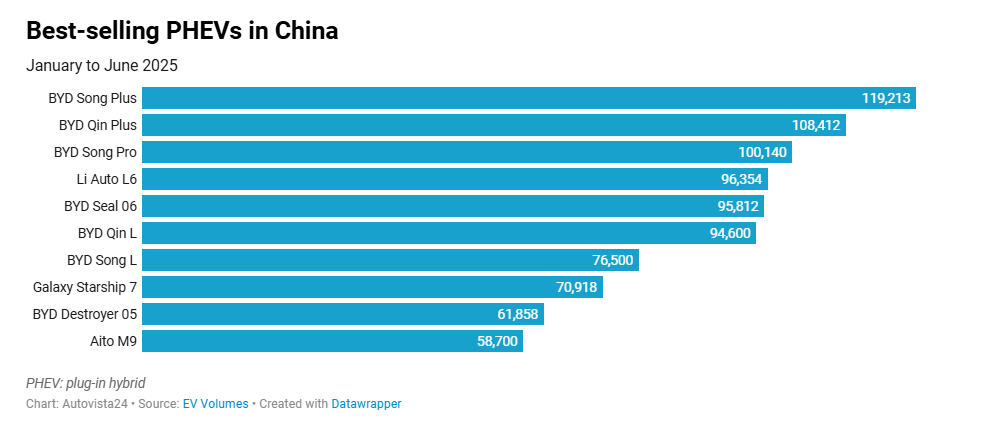
Leading the way after six months was the BYD Song Plus. Despite seeing year-on-year declines in five of the first six months of 2025, its 119,213 total meant it secured first. This translated to a 4.8% market share. However, for the first time since taking the lead in February, its lead over second declined.

Sitting 10,801 units behind in second was the BYD Qin Plus. The model also suffered declines in every month during the first half of 202. However, its volumes were enough to give it a 108,412-unit total. This was enough for a 4.4% market share.

The BYD Song Pro achieved only its second volume improvement of the year in June. This allowed it to hold third six months into the year, although its 100,140 deliveries saw it slip further behind the Qin Plus.

The first non-BYD model in the top 10 between January and June was the Li Auto L6, taking fourth. With 96,354 units, it was 3,786 deliveries behind the top three. However, this was a drop, with the model just 362 units behind in May. Nevertheless, it managed to achieve a 3.9% market share in the six-month period.

The first change in the table occurred in fifth, as the BYD Seal 06 jumped one position. Its strong performance in June left it just 542 units behind the Li Auto L6. The BYD PHEV achieved a total of 95,812 deliveries during the first half.

BYD competes with itself

The rise of the Seal 06 came at the expense of the BYD Qin L, which dropped to sixth. With 94,600 deliveries, it took a 3.8% hold of the market and was 1,212 units behind its stablemate.

Another model making moves was the BYD Song L, which improved to take seventh place. With 76,500 sales, it held a 3.1% market share.

Its rise came at the expense of the Galaxy Starship 7, which dropped to eighth with 70,918 deliveries. This meant it took a 2.9% market share. Having started the year on top, the Starship 7 has not appeared in the last two monthly top 10 standings. This has caused it to drop down the table, although it had maintained seventh position for the three previous months.

The BYD Destroyer 05 re-entered the table in ninth, having dropped out in April. It managed 61,858 sales in the first six months of 2025, equating to a 2.5% share of the PHEV total. Rounding out the top 10 was the Aito M9, with 58,700 deliveries and a 2.4% market share.

Qin Plus moves up

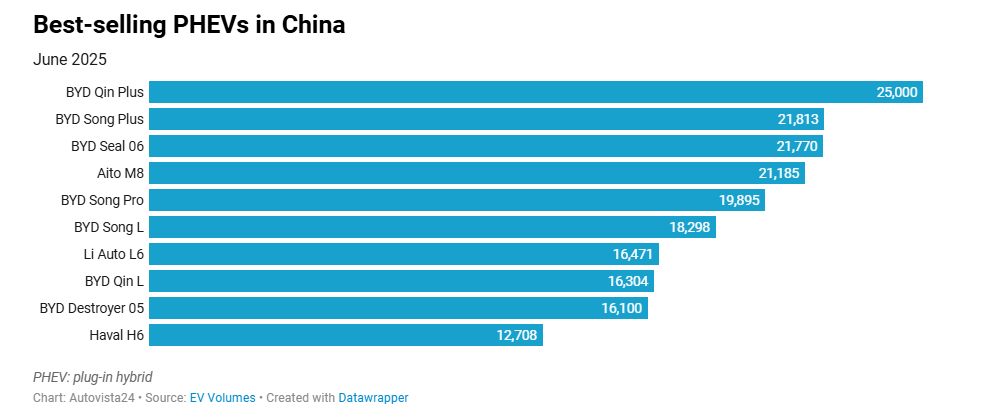
For the first time in 2025, the BYD Qin Plus topped the monthly figures in June. The model achieved 25,000 sales, although this equated to a 29.9% year-on-year drop. The total was enough for a 4.8% market share, which dipped by 4.1pp year on year.

The BYD Song Plus secured second, with 21,813 units taking to Chinese roads in the month. This was a decline of 22.6% year on year. Its hold of the overall monthly PHEV total was 4.2%, down from 7.1%.

Completing BYD’s first top-three lockout since March was the Seal 06. It recorded its best result of the first six months, with 21,770 units delivered. This was a 185.5% year-on-year improvement, while its market share jumped by 2.3pp to 4.2%.

The Aito M8, in only its third month on sale in China, took fourth with 21,815 units. This was a 4.1% hold of the monthly PHEV total. It was the model’s best performance, putting it only 585 units away from the top three.

Fifth went to the BYD Song Pro, with 19,895 sales in June, a 3% improvement over the same month last year. However, with increased competition, the model’s market share fell by 1pp, to 3.8%.

Record results in China

The BYD Song L, which first went on sale in July 2024, was sixth. It achieved 18,298 deliveries in the month, giving it a 3.5% market share.

Following in seventh was the Li Auto L6, with 16,471 sales. This was a decline of 31% year on year, with a 2.8pp fall in market share coming as a result. The model achieved 3.2% of total PHEV deliveries in the month.

Just 167 units back, the BYD Qin L also struggled in June. With 16,304 sales, the PHEV saw a 9.5% drop in deliveries. Its market share declined by 1.4pp, ending the period at 3.1%, as it took eighth place.

A further 204 deliveries behind in ninth was the BYD Destroyer 05. Despite re-entering the year-to-date top 10, it did so due to the poor performances of its competitors. With 16,100 sales, volumes declined 17.2% year on year. This meant its market hold fell from 4.9% in June 2024 to 3.1% this year.

Rounding out the top 10 was the Haval H6, making its top 10 debut with 12,708 units delivered. This was a 584.7% year-on-year improvement.

Despite having launched in September 2022, June was the first time the model achieved a five-digit monthly total. Additionally, the SUV’s June figure was nearly 1,000 units higher than its full-year total in 2024. As a result, its hold of the PHEV total in the month jumped from 0.5% last year to 2.4% in June.

This content is brought to you by Autovista24.
What are the best-selling EV brands in Europe?

Europe’s electric vehicle (EV) market had a resurgent period in the first six months of 2025. But which brands have been able to capitalise on this growth? Autovista24 journalist Tom Hooker goes through the figures from EV Volumes.

EV sales continued to climb in Europe across the second quarter of 2025, according to EV Volumes’ data. A total of 948,203 plug-ins were handed over to customers from April to June, marking a 27.4% year-on-year increase.

So, across the first half of 2025, EV deliveries grew by 23.8% compared to the same period last year. A total of 1,796,162 EVs were sold, equating to a gain of 345,691 units.

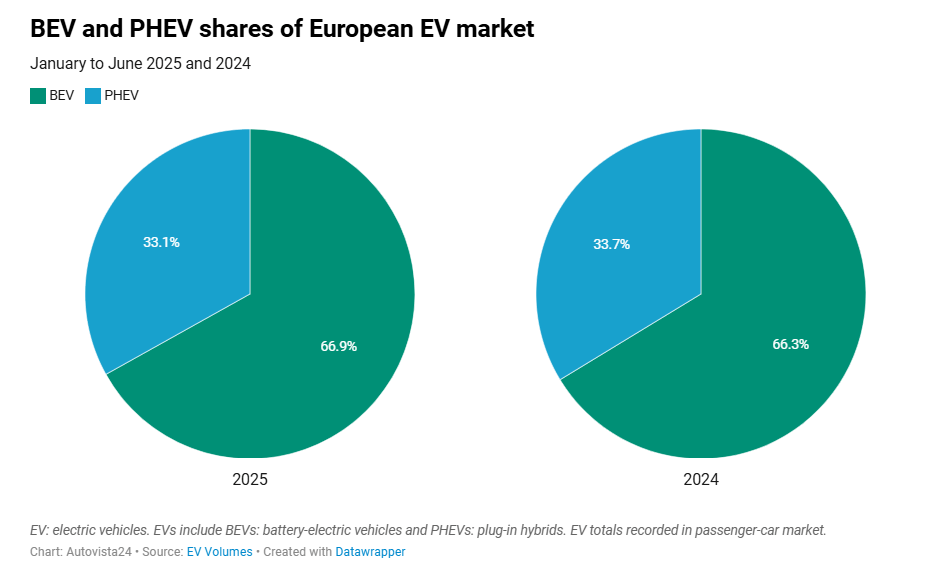
Plug-in hybrids (PHEVs) increased their share of the EV market in the second quarter. The technology accounted for 34.4% of deliveries, up by 2.8 percentage points (pp) year on year. This meant battery-electric vehicles (BEVs) represented 65.6% of sales.

However, across the first half of 2025, the share of BEVs within the EV market grew by 0.6pp to a dominant 66.9%. Consequently, PHEVs made up 33.1% of total deliveries.


Germany leads Europe

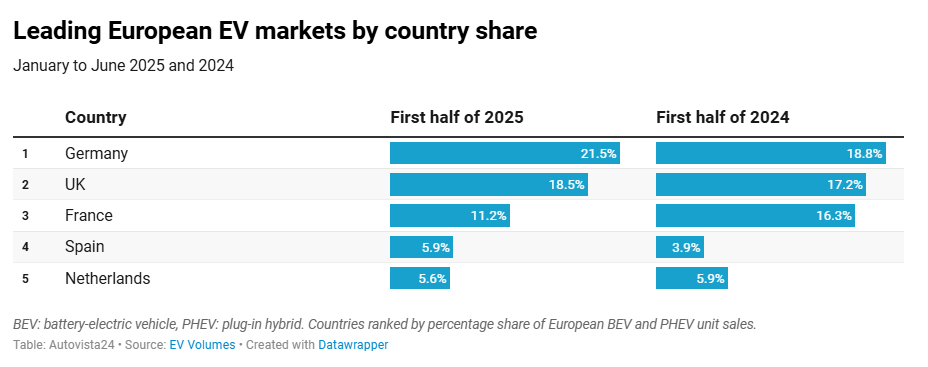
Germany recorded the most EV sales in Europe from January to June. It accounted for 21.5% of all plug-in sales in the region, up 2.7pp year on year. The UK also posted high volumes, representing 18.5% of the European EV total, an increase from its previous 17.2% share.

France was third, making up 11.2% of overall deliveries. However, this was a significant drop of 5.1pp compared to the first half of 2024. Spain was some way behind in fourth with a 5.9%, yet this was a positive progression from its previous 3.9% market hold.

The Netherlands recorded the fifth-highest number of EV sales in the first half. Its 5.6% share was down by 0.3pp from the same period in 2024.


VW’s emphatic EV victory

Volkswagen (VW) led Europe’s EV market six months into 2025. Its market share soared from 6.5% during the same period of 2024 to 11.4% this year.

This was thanks to the brand more than doubling its delivery total. Specifically, 204,805 units were handed over to customers, up 115.8% year on year. The German brand was also the best-selling carmaker in the second quarter.

VW has seen success in both the BEV and PHEV markets. Three of its ID. models featured in Europe’s all-electric top 10 from January to June, making up 56.5% of the carmaker’s EV sales. Meanwhile, its Tiguan SUV led the region’s PHEV market.

VW’s impressive performance has come at the expense of its two domestic rivals, BMW and Mercedes-Benz.

The former still sat in second, however, its market share fell by 0.7pp to 9.2%. This was despite posting a 15.1% sales growth, equating to 164,976 units. The brand enjoyed a solid performance in the second quarter, posting a 17.3% volume improvement.

The iX1 BEV was the manufacturer’s best-selling EV, accounting for 18.8% of its total in the region. The i4 BEV and X1 PHEV also made notable contributions to volumes, recording 14.2% and 12% shares, respectively.

Meanwhile, Mercedes-Benz suffered a 3.5% drop in volumes. The marque’s 121,986-unit total equated to a 6.8% share, down from 8.7%. This decline was driven by an 8.1% fall in sales during the first quarter. However, the brand recovered to record 1.5% growth from April to June.

The carmaker’s two best-selling EVs were the all-electric EQA and EQB. These models represented 16.9% and 14.1% of Mercedes-Benz’s European EV sales, respectively. Its GLC PHEV recorded significant deliveries too, representing 12.9% of the brand’s EV sales.


Contrasting EV fortunes

Tesla finished fourth in the first half of 2025. The US brand endured a 33.4% year-on-year sales decline, with 109,985 deliveries. Many parallels can be drawn between this result and VW’s turnaround.

In the first half of 2025, Tesla took a 6.1% European EV market share. This was 0.4pp below VW’s share at the same point last year. In the first half of 2024, Tesla led the market, representing 11.4% of regional EV sales. This is the same share that VW now controls.

Fifth place went to Volvo, which is struggling to match its 2024 performance. In the first half of 2025, volumes were down 17.2% to 102,533 units, while its share dropped by 2.8pp to 5.7%. The Swedish carmaker saw an even sharper sales decline of 20.9% in the second quarter, putting it seventh.

Conversely, Audi is having a more positive 2025. The marque was just 2,519 units away from entering the top five. This was thanks to a 6.3% improvement in deliveries across the first six months of the year.

The carmaker’s 100,014 EV sales meant a 5.6% share during the first half, down from 6.5% 12 months ago. This drop could be due to the success of VW, which leads the table.

Elsewhere in the group, Skoda saw sales soar as it moved up one spot to seventh. It enjoyed the biggest year-on-year increase of the top 10 brands, with a 154.4% jump to 91,943 units. Its share more than doubled, going from 2.5% to 5.1%. Its second quarter was also exceptional, with a 199.2% rise in deliveries.


Cupra and Kia drop

In turn, Cupra dropped one position to eighth. The Spanish marque saw triple-digit growth in the first quarter, with volumes up 124.6% from January to March. It could not match this performance in the second quarter, but still recorded a 56.4% increase.

This equated to an 84.6% improvement in the first half of the year, while its share rose from 2.9% to 4.3%.

Renault was another manufacturer that started the year well, with a 90% year-on-year rise in volumes during the first quarter. Its sales pace slowed slightly from April to June, as it recorded a 57.9% rise.

This equated to a 72% delivery increase in the first half of 2025, which was enough for it to move into ninth. Accordingly, its market hold rose by 1.1pp to 4.1%.

Kia dropped to 10th, with its 72,457-unit total up 12.5% compared to the first half of 2024. Despite its consistent growth, its share fell from 4.4% to 4%. This decline can be attributed to increased competition and strong sales improvement from other brands.

The brand’s position in the top 10 does not appear secure. Kia was the 12th best-selling EV carmaker from April to June, while BYD came eighth. This marked the Chinese carmaker’s first appearance in Europe’s quarterly table. The Chinese marque enjoyed the biggest year-on-year increase of any brand in the top 10 in the second quarter. Its sales grew by 335.6% to 42,005 units. BYD could enter the annual chart in the third quarter if its sales keep following this trend.

This content is brought to you by Autovista24.
How is used-vehicle retail changing?

Residual value (RV) pressure, emerging Chinese brands, growing profitability and the importance of battery-electric vehicle (BEV) sales. Autovista24 journalist Tom Hooker analyses how and why the landscape of used-vehicle retail is changing.

Industry associations, automotive experts, and carmaker representatives gathered in Frankfurt for the Used Vehicle Retail Summit. The event covered various used-car market topics, including current RV trends, building consumer trust and the sale of BEVs.

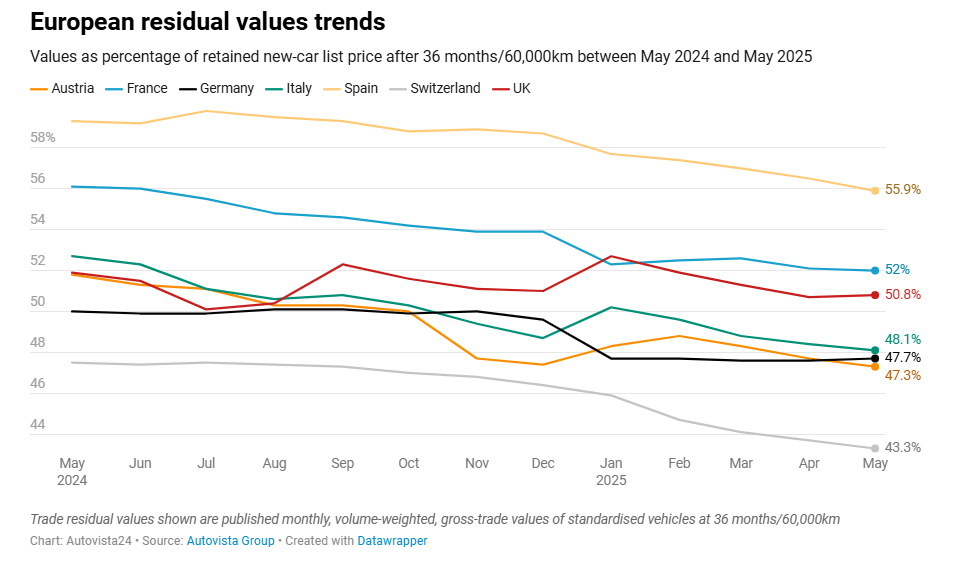
Europe’s residual value development

EV Volumes director of content, Christian Schneider, explained how RVs have changed in Europe over the last few years. ‘During the pandemic, because of all the supply shortages, a lot of people were happy that RVs were growing through the roof,’ he explained.

‘But over the last two years, we have seen that across all fuel types, across most countries in Europe, RVs are dropping. They are coming back slightly to a pre-pandemic level, but we still see RVs across various parts of Europe that are above pre-pandemic levels.

‘We see supply and demand balancing a little bit more at the moment. We also see that there is a lot of economic pressure and economies are struggling. So, of course, that has an impact on RVs. For 2025 and 2026, we do not expect the pressure on RVs to get better,’ stated Schneider.

Increased prices

He also noted the impact US tariffs could have on the European used-car market. ‘What we are expecting, if the 25% automotive tariffs stay in place after July, is that the prices for European cars in the US will grow. That also will mean that European export volume to the US will shrink.’

‘But for OEMs, they are producing cars, and they must be sold somewhere. So that means in Europe, you will see increasing volume in our European brands over the next months and maybe even years. This is not a big thing for electric vehicles (EVs), because electrification in the US is not advanced.’

He highlighted that the bigger impact will be on internal-combustion engine (ICE) vehicles. Overall, if higher US tariffs remain after July, there will be additional risk to RVs. EV Volumes is also observing an increasing number of used BEV sales. However, RVs are dropping at an even steeper rate than the overall market.

This is because more BEVs are entering the market than before. However, most of this volume is not coming from private buyers. Instead, it is being pushed through fleet channels.

Furthermore, a lot of the incentives offered in European countries are only offered on the new-car market. These factors are generating an artificial oversupply for used-car markets.

China’s growing influence

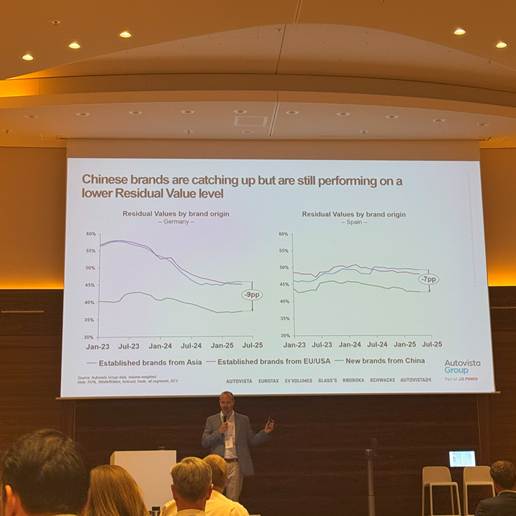
Chinese BEV volumes are forecast to continue to grow in Europe over the next few years. Carmakers from China held a 7% share of the European new-car market in 2024. EV Volumes expects this to grow to 10% this year.

Despite this, RVs of these models still trail behind BEVs originating from other regions. ‘In Germany, Chinese brands are performing nine percentage points (pp) lower than those from established Asian, European or US brands,’ highlighted Schneider.

EV Volumes director of content, Christian Schneider

‘But we saw over time that this is getting smaller. Around one year ago, there was approximately a 14pp or 15pp difference between the brands. So, they are closing the gap, but we still see that the brand reputation takes significant time to fill up, especially for used-car buyers.’

In Spain, this gap is smaller, as the country’s domestic brands are not as strong compared to those in Germany.

Used-car retail

With overall BEV RVs struggling compared to other powertrains, and an increasing number of all-electric models entering the used-car market, how can dealerships survive?

As AECDR secretary general Friedrich Trosse explained, a more effective dealership and communication strategy is needed to keep used-car buyers engaged.

‘The used-car market is going to be the low-income segment of BEVs, because we are never going to have something like a Volkswagen Beetle ever again that is affordable and has modern technology,’ he commented.

For retailers, planning their overall used-car market strategy is also becoming more important, especially when compared to their new-car business.

‘I think that used cars, for retailers and dealers, are an amazing opportunity. In some mature markets, the used-car business is double the size of the new-car business,’ outlined CARA board chairman Luis-Maria Perez-Serano.

‘You can achieve more money and higher margins. Many retailers are now earning more money from used cars than new cars. What is maybe even more important is that used cars are essential for customer retention. They play a major role as the first entry point for buyers,’ he said.

However, Serano added that the used-car market is a complex business. Having a good digital interface is essential for dealers, and he believes more can be done to make the customer’s digital journey easier. This includes showing EV battery health checks online.

Serano also discussed cross-border sales in Europe, and that despite the EU being considered as a single economic market, this is not yet the case for the used-car market. However, improving the facilitation of these sales could create opportunities for retailers who could maximise revenue by moving vehicles to other countries.

Additionally, he stated that there is still a lot to do in terms of educating and training staff in used-car sales and remarketing.

Missed opportunities in retail

‘I still see a lot of missed opportunities in every country. I know most markets have evolved into a more balanced ratio between using new and used cars, but the profitability has not been in the new cars as it has been over the past years,’ explained vice president and chairman of CECRA, Rodrigo Ferreira da Silva.

He also highlighted the importance of the customer having access to accurate in-vehicle data. He advocated for the implementation of a car pass at a European level.

This is a vehicle diagnostic report that provides a certificate to buyers at the time of sale, verifying the vehicle’s mileage accuracy. It has been designed to fight against odometer tampering in the used car market. However, the service is currently only offered in Belgium and the Netherlands.

This content is brought to you by Autovista24.
Which brand sold the most EVs in Europe in 2024?

The European electric vehicle (EV) market stalled in 2024, following years of growth. But which carmaker came out on top in the region, and did the gap to the leading brand close? Autovista24 journalist Tom Hooker assesses the data.

Over 2.96million EVs were registered in Europe across 2024, according to the latest data from EV Volumes. This equated to a year-on-year decline of 1.8% and a loss of 55,746 units.

However, EVs did see growth in December, bouncing back after recording a fall in November. Registrations improved by 1.3%, with 298,457 deliveries. This represented a gain of 3,713 units compared to one year ago.

The month saw the highest EV volume total since June 2023. This meant it beat March for the best figures recorded in the year.

Battery-electric vehicles (BEVs) accounted for the majority of the EV market in 2024. The technology accounted for 67.7% of all plug-in registrations, up 0.6 percentage points (pp) from 2023.

Plug-in hybrids (PHEVs) captured 32.3% of the market in the full year, down from 32.9%. The powertrain suffered a sharper delivery decline across 2024 than all-electric vehicles did.

BEVs took a 69.5% share of plug-in volumes during December, a drop of 0.7pp compared to one year ago. PHEVs made up 30.5% of total registrations in the month, up from 29.8%.

Who topped Europe’s EV market?

Tesla topped the European EV market for the third year in a row, with the Model Y and Model 3 leading the continent’s plug-in market at the end of 2024. The manufacturer reached 328,036 deliveries from January to December, more than 35,000 units ahead of second place.

However, this figure was a 10.4% decline on its 2023 performance. The carmaker made up 11.1% of the overall plug-in market, down 1pp year on year.

BMW secured second, replicating its result from 2023. This was thanks to 292,407 registrations, representing an increase of 10.7% or 28,156 units year on year. It also marked the brand’s highest-ever European EV total, helped by its iX1 BEV and X1 PHEV. BMW models accounted for 9.9% of deliveries, up from 8.7% in 2023.

Third place went to Mercedes-Benz, improving on its fourth-place finish in 2023. It posted a record 258,677 registrations. This equated to a growth of 10% and a 23,515-unit gain compared to the previous reporting period.

The improvement was driven by models such as the Mercedes-Benz GLC, which landed third in the region’s PHEV table. This gave the brand an 8.7% share of the total volume, an improvement of 0.9pp.

Volvo finished 2024 in fourth, a significant progression from its sixth-place finish in 2023. Its EX30 BEV performed well, while its XC60 led the PHEV market. The SUV was also joined by the XC90 in the top 10.

The manufacturer reached a best-ever total of 239,255 deliveries, a 42% surge year on year. This was the biggest percentage growth recorded in the top 10 and meant an additional 70,745 models were registered. The manufacturer took an 8.1% share in 2024, up from 5.6%.

VW falls from grace in Europe

In fifth came Volkswagen (VW), falling from third place in the previous year. The carmaker suffered a 6.7% decline in volumes, with 229,836 deliveries. This was a loss of 16,546 units compared to one year ago. VW’s share fell from 8.2% to 7.8% in 2024.

Audi landed in sixth. EV registrations for the brand dropped 0.8% to 172,665 units, meaning it fell one position compared to 2023. This is despite the strong performance of its Q4 e-Tron. Overall, the carmaker’s 5.8% market hold was stable from 2023.

Seventh was taken by Kia, with 118,264 deliveries. Despite matching its 2023 placement, this was a 13% decline in volume compared to one year ago. It equated to a difference of 17,720 units. The marque captured 4% of the EV market, a drop of 0.5pp.

Peugeot took eighth, also replicating its performance from the previous year. However, its total of 115,771 registrations was down 10.9% and 14,174 units year on year. The manufacturer accounted for 3.9% of deliveries, down from 4.3%.

In ninth, Skoda moved up two places from its 2023 result. The carmaker saw volumes rise 4.1% compared to the previous reporting period, with 101,629 deliveries. This was mostly driven by its Enyaq BEV, which represented 78% of the overall figure. Skoda models made up 3.4% of the plug-in market, an increase of 0.2pp.

Hyundai rounded out the top 10, matching its 2023 ranking. Yet, the brand recorded a 14.6% decline in registrations, with 94,258 units. This was a loss of 16,053 units compared to 2023. It took a 3.2% share, falling from 3.7%.

Tesla deliveries grow in Europe

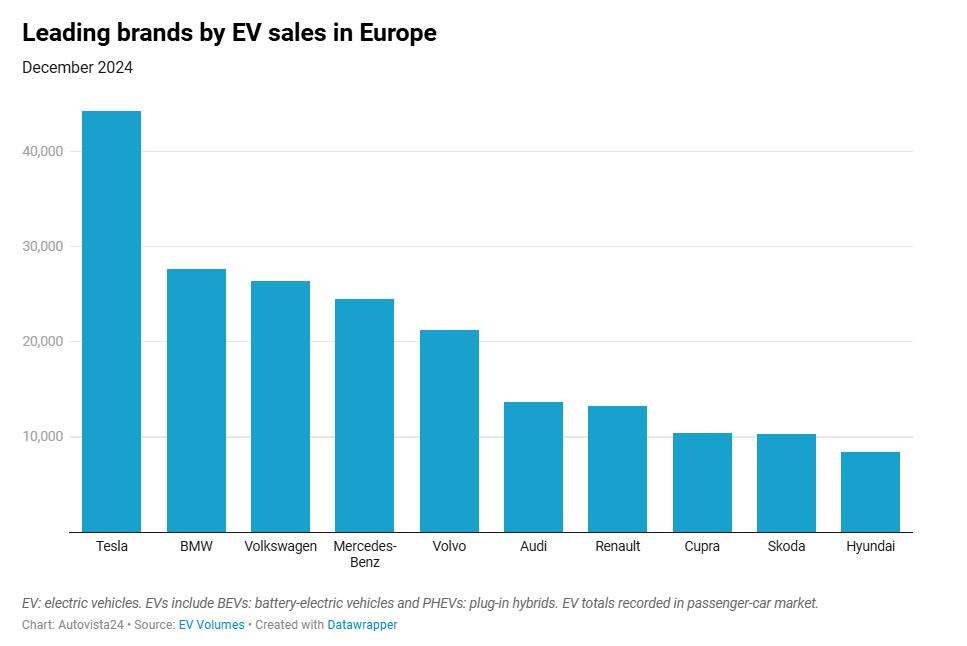
Tesla was the best-selling EV manufacturer in December as it experienced its usual end-of-quarter delivery peak. It last led the market in September 2024. The marque reached 44,257 registrations in the month, a 13.2% growth year on year.

Its two most popular BEVs, the Model Y and Model 3, saw improved volumes in December. This gave Tesla a comfortable gap to the competition, as it sat 16,592 units ahead of second place. The carmaker represented 14.8% of the plug-in market, a rise of 1.5pp from December 2023.

BMW fell to second after leading the market in November. It delivered 27,665 units in the reporting month, a drop of 16.2% compared to one year ago. Yet, December was BMW’s second-highest volume month of the year, with its X1 and X5 PHEVs performing well. The brand accounted for 9.3% of registrations, down from 11.2%.

VW took third, with 26,397 deliveries. This represented year-on-year growth of 17.3%, marking its fourth month of registering around 26,000 units. Notably, demand for its ID.7 BEV and Tiguan PHEV picked up. The manufacturer took an 8.8% market share, an increase of 1.2pp.

Next came Mercedes-Benz, recording 24,528 deliveries, improving by 4.6% from 12 months prior. December represented the marque’s highest volume month since March 2024, as its GLC PHEV posted positive figures. It made up 8.2% of the overall EV total, up from 8%.

Volvo finished fifth in December, thanks to its biggest monthly volume since June 2024. The brand posted 21,194 registrations, a 28.1% year-on-year surge. This equated to a 4,645-unit gain, with its XC60 and XC90 PHEVs recording good growth. Volvo models represented 7.1% of the plug-in market, an improvement of 1.5pp.

European brands fall

Audi secured sixth, with 13,646 deliveries. This equated to a fall of 17.6% compared to 12 months ago, despite its Q4 e-Tron BEV posting growth. Its 4.6% share was down from 5.6%.

Renault saw volumes surge 62.5% in December, benefiting from a strong month for the Renault 5. The carmaker recorded 13,285 registrations, an increase of 62.5% or 5,112 units year on year. This was the highest monthly total since December 2022. The brand accounted for 4.5% of deliveries, up 1.7pp.

Cupra ended the month in eighth, with 10,394 registrations. This was a drop of 6% compared to December 2023, as volumes for its Formentor PHEV struggled. However, December marked Cupra’s biggest delivery month of 2024. The brand made up 3.5% of the overall total, a decline of 0.3pp.

Skoda landed in ninth, posting 10,285 registrations, just 109 units behind Cupra. This was a decline of 0.8% year on year and its lowest volume month since August 2024. Its Enyaq BEV, which makes up the majority of its plug-in deliveries, struggled in December. The manufacturer took a 3.4% share, down from 3.5%.

Hyundai placed 10th, with 8,463 registrations. This equated to a fall of 6% compared to December 2023. The carmaker represented 2.8% of the EV market, a drop of 0.3pp.

This content is brought to you by Autovista24.
What was the most popular EV worldwide in 2023?

The global electric vehicle (EV) market broke records throughout 2023. Leading this charge was the Tesla Model Y. José Pontes, data director at EV-volumes.com, unpacks the year and its most popular performers.

New EVs, consisting of battery-electric vehicles (BEVs) and plug-in hybrids (PHEVs), saw global registrations jump 35% year on year in 2023. This allowed the electric market to end above the 13 million mark for the first time.

Plug-in models made up a record 22% of the entire new-car market in December, with BEVs accounting for 15% alone. This pushed 2023’s total EV share to 16%, a small rise from 14% in 2022. BEVs made up 11% of registrations worldwide last year, up from 10% in the previous year. It is worth considering that the overall global new-car market experienced double-digit growth in 2023.

PHEVs (up 47%) saw registrations grow more quickly across 2023 than BEVs (up 30%). This meant the hybrid powertrain increased its share of the EV market, reaching 31%, up from 28% in 2022. The PHEV share has been fluctuating between 26% and 31% since 2018, supporting the notion that the technology could remain relevant for a while.

Best-selling car in 2023

The Tesla Model Y recorded 1,211,601 registrations across 2023. This made it the best-selling model in both the new EV and the overall new-car market. The BEV saw deliveries grow 57% year on year, up from 771,000 units in 2022. The crossover can be expected to stay a market leader in 2024.

The BYD Song secured second place, as the Chinese SUV ended the year with 636,533 registrations, up 33% on 2022. Meanwhile, the Tesla Model 3 hit a new record of 529,287 registrations, putting it in third.

But despite its recent refresh, the Model 3 has reached full maturity. The sedan has seen its market share erode from 14% in 2019 to 12% in 2020, then 8% in 2021, 4.7% in 2022 and 3.9% last year. Sales have struggled to maintain momentum since hitting over 500,000 units in 2021.

Compared with 2019, last year’s result represents growth of 6% for the Model 3. But in the same period, the EV market more than doubled from 6.6 million units to nearly 13.7 million units, illustrating the BEV’s market limits.

BYD’s block

Below the top three, there was a block of BYD models. This included the Qin Plus in fourth, the Yuan Plus/Atto 3 in fifth, and the Dolphin in sixth. The BYD Seagull ended the year in seventh, profiting from a great performance in December and jumping two places. This meant the top seven places were dominated by just two carmakers.

The BYD Han won another full-size category title, followed by its sibling, the Tang. But both models saw declining sales in 2023, by 17% for the Han and 7% for the Tang. It will likely be much harder for the Chinese brand to retain the full-size category title in 2024.

In the second half of the table, the Volkswagen (VW) ID.3 was up one position to 15th. Last year was a great one for the hatchback, as its sales jumped 79% year on year to 139,268 units. Thanks primarily to its success in China, this is the first time the BEV crossed the 100,000 mark.

GAC Aion also had a good year with its Y and S BEVs, with sales almost doubling. This put the models in ninth and 11th respectively. But Li Auto made even greater strides, as the startup placed all three of its full-sized EVs in the top 20.

Four models from legacy OEMs made it to the top 20 in 2022, namely the VW ID.4, the Hyundai Ioniq 5, the Ford Mustang Mach-E, and the Kia EV6. But this count fell to just two in 2023, with the VW ID.4 in 12th and ID.3 in 15th. Considering the Audi Q4 e-Tron finished in 21st, the top three models from a legacy OEM all belonged to VW Group.

Success by segment

Chinese models took the EV A-segment by storm in 2023. Coming seventh in the overall EV ranking, the BYD Seagull took the category title from the eighth-place Wuling Mini EV. The Seagull is a top contender to repeat its success in 2024. The Changan Lumin came third in the category, far from the top two.

The B-segment also saw many Chinese models succeed. The category was led by the BYD Dolphin which came sixth overall, followed by the Wuling Bingo in 13th. The Peugeot e-208 came next but at a great distance from the top two with some 51,000 registrations. This was more than 100,000 units below the Bingo and some 300,000 units behind the Dolphin.

The C-segment was led by the BYD Yuan Plus/Atto 3. The crossover ended 2023 at 418,994 units, double its 2022 result. The GAC Aion Y came next with 235,861 deliveries, followed by the VW ID.4 with 192,686 registrations. Expect an exciting competition between the top two this year. However, the BYD Yuan Up, a smaller and cheaper sibling of the Yuan Plus, could provide a surprise.

Tesla’s D-segment

Tesla ruled over the D-segment in 2023. The Model Y was the clear leader, while the Model 3 came third. Between the two was the BYD Song. However, the Model Y already looks set to secure the category win again in 2024.

Three Chinese models commanded the E and F-segments. The BYD Han recorded 228,007 registrations, the BYD Tang 141,581 registrations, and the Li Auto L7 134,089 registrations. Should Li Auto or Aito want to compete for a top spot this year, a minimum production capacity of 150,000 units a year will be the bare minimum. Even so, the category leader will likely end up past the 300,000-unit mark.

Pickup trucks saw a second year of relevance in 2023 with around 52,000 deliveries, up 44% year on year. The Ford F-150 Lightening posted roughly 25,000 deliveries while the Rivian R1T managed some 15,000. Geely’s Radar RD6 took third with 4,736 units. In 2024, the Tesla Cybertruck is likely to disrupt this trio.

A total of 9,511 fuel-cell electric vehicles were registered in 2023, down 38% on 2022. This followed a drop from 2021, the year FCEVs reached a peak of 15,434 registrations. In 2023, the Hyundai Nexo (5,000 units) beat the Toyota Mirai (4,000 units).

Best-selling brands in 2023

In terms of brand volumes, BYD beat Tesla by a significant margin in 2023. With a 56% year-on-year growth rate, the Chinese company was the fastest-growing marque in the top three, allowing it to increase its lead to over one million units.

However, this trend is unlikely to continue into 2024. BYD is running out of room to grow in its domestic market, meaning the demand ceiling is closing in. Yet this supports the company’s overseas strategies, plans which could come to define the EV market in 2024.

In 2023, the Chinese brand started to export its EVs in significant volumes. Israel saw 15,000 units, Brazil 18,000 units, and Thailand 30,000 units.

In second place, Tesla’s market share continued to suffer erosion. This sat at 17% in 2019, 16% in 2020, 14% in 2021, and then 13% in 2022 and 2023. This could potentially stabilise around 10% in the future. The US carmaker will need to diversify its line-up if it wants to retake the brand title.

Due to a slow first half of the year, SGMW ended in sixth allowing BMW to take third. It may be difficult for the German carmaker to hold on to this position in 2024, considering the pack of fast-growing Chinese brands behind it.

In fourth, GAC Aion grew 78% to some 484,000 units, however, this growth will be difficult to sustain. So far, the brand has not found a way to replicate the success of its S and Y models.

This puts the carmaker in the sights of the rapidly-growing Li Auto in seventh. Its three current models will reach maturity in 2024. Then there are the upcoming launches of the Mega and the L6, which could mean the brand will deliver up to 700,000 units next year.

Benefitting from a slow December for Toyota, Nio was also able to climb up the ranking in the last month of 2023. The carmaker ended the year in 16th, a five-position jump from its previous year’s standing. However, it could be difficult for the startup to remain in this spot given a lack of new models for 2024 and a sluggish export performance.

The other two brands to benefit from Toyota’s downfall were Ford, climbing one position to 17th, and Jeep, up to 18th. Out of all the legacy marques on the table, Jeep was the fastest growing, having seen its sales jump 53% compared to 2022. It ended the year as Stellantis’ best-selling brand, 23,000 units ahead of Peugeot in 22nd.

Outstanding OEMs in 2023

Gathering EV sales by automotive group, BYD claimed a 22% market share, with 3,012,070 registrations. Tesla came second with an 13.2% share and 1,808,652 deliveries. This puts the two OEMs in a league of their own, controlling over a third of the market together.

VW Group remained in third, with a 7.3% market share, making it the leading legacy OEM. Meanwhile, Geely–Volvo (6.8% share) took fourth from SAIC (5.8% share) towards the end of the year. This means the fight for third in 2024 will be one to watch.

Stellantis (4.2% share) stayed in sixth but has lost half a percentage point compared to the end of 2022. However, the OEM delivered nearly 600,000 units last year. This means it should reach the one-million-unit scale for EV profitability by 2025, or possibly 2026.

BMW Group (4.1%) rose to seventh place and the German OEM should be competing for sixth throughout 2024. Hyundai Motor Group (3.7% share) dropped from seventh in 2022 to ninth in 2023, losing almost a full percentage point from 4.6%. The Korean OEM was also surpassed by GAC, which ended the year with a 3.8% share.

Battle of the BEVs

Looking only at BEVs, Tesla took the 2023 OEM title with 19.1% of the global market. This was up from 18.2% in 2022 but was down from the 23% it commanded at the end of 2020. Second went to BYD with a 16.5% share of the BEV market.

While Tesla’s market is likely to erode slightly in 2024, BYD will keep gaining share. This will be thanks to a larger number of BEVs in BYD’s line-up, including the Yuan Up and Sea Lion. Additionally, exports will be more focused on BEVs, with PHEVs only being used in select markets.

VW Group took third with an 8% share, while SAIC took fourth with a 7.9% holding. In fifth, Geely–Volvo claimed 6.2% of the market. Sixth-place GAC was a sizable distance behind, with a 5.3% share. Nevertheless, the OEM had a positive 2023, up from 4% in 2022.

BYD nears local limit

There are a number of trends already emerging which provide a good insight into what the automotive market can expect from the EV segment in 2024 and beyond.

The BYD brand is already close to its demand ceiling in China, meaning the OEM is increasingly focused on its premium brands. This includes Yangwang, Fangchengbao and Denza.

With a higher average price, margins are expected to improve. This will give BYD more options when pricing its mainstream models. But with competition heating up in the Chinese EV market, BYD will need to keep its line-up fresh to hold on to its share, while also considering pricing.

As such, growth will have to come from overseas markets which is something BYD has been preparing for. As well as buying and chartering its own vehicle vessel, it is building factories in places such as Thailand, Indonesia, Brazil, and Hungary.

Tesla’s production planning

Tesla delivered 1,808,652 units in 2023, but with little in the way of new offerings, the carmaker is unlikely to see rapid growth in 2024.

Tesla’s current issue is its lack of product planning. The Model S is now 12 years old, making a second generation rather overdue. The Model X is in its ninth year, meaning a new version should have been presented by now.

Meanwhile, the Model Y (2020) has reached maturity as has the Model 3, which launched in 2017 and only saw a refresh in 2023. Their successors should, therefore, be on the drawing board. However, this does not appear to be the case. The carmaker would do well to consider how it manages the lifecycles of its products.

VW Group and Geely

While suffering some management changes in recent years, VW Group is still the best-performing legacy OEM by far. With close to one million EV deliveries in 2023, its long-term survival is well assured.

Moving into 2024, the OEM’s leading models will mature. The only new models will be the VW ID.7, the Cupra Tavascan, the Skoda Elroq, the Porsche Macan, and the Audi Q6/A6 e-Tron.

Meanwhile, Geely has been steadily gaining ground in the EV OEM ranking in the last few years, ending 2023 in fourth with 925,111 registrations. This was only some 69,000 units below VW Group.

SAIC the export expert

While SAIC excels at exporting, it could do better locally. The OEM aims to sell around 1.4 million vehicles abroad this year. However, this does include models powered by internal-combustion engines.

With 14 new EVs expected by 2026, SAIC hopes to replicate the MG4’s success with other launches. This includes venturing into the premium end of export markets with its new IM brand. Therefore, 2024 is likely to see a new MG5 station wagon, a ZS crossover, and a flagship SUV model.

Another monthly title for Tesla

The Tesla Model Y took another best-seller position in December, with 128,410 deliveries. The crossover can be expected to keep racking up monthly titles this year as it has reached full maturity. With a refreshed version coming around April, it is likely to be the best year of the current generation.

In second place, the BYD Song hit a record 76,086 registrations. This could be its peak, with the recently-arrived Song L ready to cannibalise a significant volume of its sales in 2024, as will the upcoming Sea Lion.

Third place in December went to the Tesla Model 3, which posted more than 56,896 deliveries, ending well ahead of the BYD Qin Plus in fourth (44,701 units). Further down the ranking the Wuling Bingo came eighth (27,458 units), thanks to its continuous production ramp-up. The small EV seems ready to compete with BYD’s leading models for a top spot in 2024. 

The VW ID.3 finished the month in 15th. The model recorded 17,861 registrations globally in December, its best score since the end of 2020 when VW delivered units to dealerships to comply with emission requirements.

Thanks to price cuts in China, the ID.3 saw its fortunes change completely in the market. This helped compensate for its milder performance in Europe. Elsewhere in the compact category, SAIC’s MG4 (Mulan in China) scored 12,964 registrations in December, its second record score in a row.

Made in China

Some of December’s most significant figures were recorded in the full-size category. The entire Li Auto line-up reached record heights. The L7 marked 20,428 registrations, the L8 saw 15,013 deliveries, while the L9 marked 14,913 units.

December’s best-selling full-size model was the Aito M7, which took ninth place in the EV market with 25,545 deliveries. With Huawei putting its weight behind the brand, sales increasing rapidly.

Every model in December’s top 20 was made in China. A total of 16 belonged to Chinese carmakers, with seven coming from BYD alone. This illustrates the importance of the Chinese market in the broader EV industry.

Successful SUVs

Outside of December’s top 20, the Geely Panda Mini was close to joining the table, having ended the month fewer than 300 units behind the BYD Tang in 20th. The compact Audi Q4 e-Tron was also close, with 11,260 registrations.

In the midsize category, SUVs were trending with several record-breakers. After several years on the market, the Volvo XC60 PHEV hit a best-ever global total of 7,868 registrations. Deliveries of the Lynk & Co 08 PHEV reached 10,055 units, while SAIC’s IM LS6 posted 9,878 units, and the Changan’s Deepal S7 11,360 units.

However, the recent Wuling Starlight from SGMW proved that success is not restricted to SUVs, recording 8,050 deliveries in December. In the full-size category, the Jeep Grand Cherokee PHEV reached a record 7,299 registrations.

The BMW i4 achieved another registration record, with 11,203 units delivered in December. This made it the best-selling EV produced outside of China. However, the i4 only posted a fifth of the registrations achieved by its competitor, the Tesla Model 3.

The BMW iX1 also achieved a new best of 8,775 deliveries, its third record in a row. Meanwhile, the iX also shined, with 7,027 registrations.

A record month for brands

BYD managed another record month in December, this time with 320,928 registrations. It once again beat Tesla, which posted 195,265 deliveries.

SGMW came third thanks to a best-ever monthly tally of 69,912 registrations. Its three models (the Mini EV, Bingo, and Starlight) contributed decisively to this performance. In fourth with 59,480 deliveries, BMW had a record month thanks largely to the success of its i4 fastback (11,203 registrations), but also the iX1 (8,775 units) and iX (7,027 units).

VW came fifth with 52,042 registrations, followed closely by Li Auto with a new best of 50,356 units. In the same month last year, it posted 21,233 registrations. In eighth, Changan recorded 43,095 deliveries, its second-best performance in a row, thanks to the Lumin and Deepal S7.

MG4 boosts SAIC

SAIC made it to 11th with a record 35,334 registrations. This was owing to the performance of its star player, the MG4. Aito rocketed up to 12th with its M7 SUV and even larger M9. The brand hit a record 30,108 units in December.

In 13th, Audi also registered its best month with 28,024 deliveries in December, thanks to the Q4 e-Tron. XPeng came 17th, with 7,673 registrations of its G6 midsize SUV in December. This allowed the carmaker to hit a total of 20,105 units in the month, almost catching Hyundai in 16th (20,631 units). Chery came 20th thanks to the positive results of the QQ Ice Cream (7,462 units).

Jeep landed in 21st, making it the best-selling US legacy brand as well as Stellantis’ best-selling marque. With 17,723 registrations, it achieved a new record. This was down to the continued success of the Wrangler PHEV and Grand Cherokee PHEV.

Lynk & Co came 22nd with a new best of 17,505 deliveries. The 08 SUV accounted for the bulk of the registrations (10,055 units), allowing the Chinese brand to end close to the table.

This content is brought to you by Autovista24.
Siirry Autovista24-verkkosivulle

CES 2024: The automotive AI journey has just begun

A new path of technological automotive development is emerging, evidenced by a strong focus on artificial intelligence (AI) at CES 2024. Autovista24 special content editor, Phil Curry, considers where this road could take the industry.

Just two letters encapsulated the majority of discussions and launches at CES 2024 – AI. Every sector appeared invested in artificial intelligence, and the automotive market was no exception.

From personal assistants to predictive maintenance, AI could revolutionise mobility. However, understanding the technology is a complex task, as is the process of using it to gain results.

But almost all carmakers appear to be working on AI strategies. Some are planning simple integrations in the near future, while others are working on utilising the technology inside and outside the vehicle.

Huge potential

In a panel session presented by EY, the potential of AI in the automotive market was discussed, along with the needs of the industry to ensure it can work as effectively as possible.

Sabine Scheunert, former vice president of digital and IT sales/marketing at Mercedes-Benz, said: ‘Today, there is not a single carmaker that is not utilising AI. It starts with the clear potential of huge efficiency and helps to shorten the development cycle of new vehicles, which is a real efficiency driver. It is also useful in production lines, especially with quality management.

‘However, AI also has an important part to play in the customer journey. Call centres are integrating bots into their systems, and these can sufficiently answer the requests of the customers. So, in customer experience terms, the use of AI in the automotive industry has huge potential,’ she added.

Three AI areas

‘By 2030, we expect $74.5 billion (€68.5 billion) will have been invested in AI by automotive companies, the question now is, what do we do with that money, and how do we commercialise it?’ commented Constantin Gall, managing partner at EY.

‘We see three areas where AI can help benefit the mobility market: proactive care, proactive journey and proactive mobility.’

Proactive journey could see AI examine a driver’s commute and schedule to ensure efficient time management, also examining traffic trends. Proactive mobility complements autonomous driving, as AI brings augmented reality and in-car infotainment, benefitting users while the car is in motion.

Proactive care will see car owners offered a hassle-free experience when it comes to their vehicles. AI could take care of admin and logistics, such as insuring the vehicle, booking maintenance and even predicting potential issues. However, it may also offer proactive communication and recommendations, leaving the financial decisions up to the driver.

This means AI could help to maintain customer loyalty, especially when it comes to electric vehicles (EVs) which are subject to less maintenance. The technology could help ensure drivers interact with original manufacturers instead of considering a third party.

Benefitting aftersales

Scheunert highlighted how AI could have a crucial role to play in keeping customers loyal to brands through predictive maintenance.

As cars get older, they will end up moving out of the franchised dealer servicing schemes and into the independent repair sector. Scheunert suggested that aftersales is not an area that OEMs currently concentrate on.

‘It can cost around seven times more to reconquer a customer you have lost to bring them back to your aftersales service,’ Scheunert stated. ‘The aftersales area is certainly a market where AI can be developed further to benefit.

‘Vehicles today have a lot of sensoric information, monitoring everything that is happening around the car, including breakdowns or damaged parts. The next step is to connect the data to allow for a prediction on whether a part is close to the end of its life, but then also connecting to suppliers to ship this part to the nearest service centre, or even to the customer with instructions of how to fit the part themselves,’ she said.

Investment black hole

The AI options and potential benefits to businesses and consumers alike are vast. To utilise the technology fully, the correct data needs to be generated and analysed, with systems required to process all the information. Otherwise, carmakers and suppliers risk pouring millions into a black hole of development.

‘There is still a lack of real understanding of how the automotive industry can put AI to good use, in order to meet the user experience we would like to see,’ stated Damian Barnett, Luxoft CTO.

‘We need to make sure we are creating the right data, to allow us to collect the data we need and drive the results that we would like to see coming out of AI,’ he added.

Carmakers working on AI

Alongside the discussions, there were plenty of automotive businesses at CES 2024 revealing their AI plans.

BMW Group announced the integration of generative AI into its voice assistant. Together with its partner Amazon, the carmaker showcased a new system powered by the Alexa large-language model (LLM). The current development project is creating the foundations for a potential rollout.

Complex processing capabilities, which enable human-like interactions and conversations, have not yet been integrated into BMW vehicles. This is now made possible by LLMs, which are trained on enormous sets of data, allowing them to generate plausible language.

Mercedes-Benz is also integrating generative AI into its MBUX virtual assistant. The carmaker is aiming to make user interactions more human-like.

‘The Mercedes-Benz user experience of tomorrow will be hyper-personalised. With generative AI, our MBUX virtual assistant brings more trust and empathy to the relationship between car and driver,’ commented Magnus Östberg, chief software officer, Mercedes-Benz AG.

‘Thanks to our MB.OS chip-to-cloud architecture, our future vehicles will provide customers with exactly what they need when they need it.’

The carmaker explained that its MBUX virtual assistant uses generative AI and proactive intelligence to make life as easy, convenient and comfortable as possible. The system can offer helpful suggestions based on learned behaviour and situational context. Examples include playing the latest news in the morning or starting a preferred massage programme at the end of the working day.

The AI can also learn a driver’s movements and schedule, and link into digital calendars, to offer options should circumstances change. This may include automatically preparing a call should the user be running late for an appointment. The system can also learn individual driver preferences and prepare the vehicle accordingly, including music choices and ambient lighting.

ChatGPT comes to cars

One of the most well-known AI chatbots, ChatGPT, is to be utilised by Volkswagen (VW), with the system integrated into the carmaker’s IDA voice assistant by Cerence Chat Pro. This means the technology can offer new functionality and respond to drivers with detailed answers while understanding their basic needs and reacting to them.

‘Thanks to the seamless integration of ChatGPT and strong collaboration with our partner, Cerence, we are offering our drivers added value and direct access to the AI-based research tool,’ commented Kai Grünitz, member of the board of management at VW responsible for technical development.

The integration of AI helps to keep the cabin experience intuitive and personalised, while also giving the driver the information they need when required.

‘With the rise of generative AI and LLMs we are now entering a new era of computing, large language models will become the new AI agents, enabling a single conversational interface across applications, based on users’ personal preferences,’ said Stefan Ortmanns, CEO of Cerence.

‘This will help to transform the in-car assistant into a human-like companion. Our smart arbitration, embedded in the VW solution, directs questions, routes, and specific voice commands, and allows VW to feed the system with customised information,’ he said.

Using AI, VW says the IDA voice assistant can be used to control the infotainment, navigation, and air conditioning, or to answer general knowledge questions. In the future, AI will provide additional information in response to more complex questions as part of its continuously expanding capabilities.

Advancing the use of AI

Sony provided an update on its Sony Honda Mobility (SHM) business, including a new partnership with Microsoft. This collaboration aims to develop a conversational personal agent using the Azure OpenAI service.

‘Generative AI is a new canvas that is amplifying human creativity and creating opportunities for creators and designers to completely transform the in-vehicle experience,’ stated Jessica Hawk, corporate vice president, data, AI, digital applications and product marketing at Microsoft.

‘As these new technologies come forward, safe and responsible AI will continue to be a top priority for both Microsoft and Sony.’

SHM is also looking to build upon both automated driving and advanced driver-assistance systems (ADAS) by using AI in mobility. The company is adopting Vison Transformer, a deep-learning model for natural language processing, which also specialises in image recognition.

This will improve how ADAS can perceive the world, alongside greater path planning thanks to machine learning. Cars will be able to see the road ahead more clearly and consider hazards, before taking appropriate action such as applying brakes. This means AI will play a significant role in vehicle safety.

Overall, the automotive industry is still learning about AI and its potential. With most official announcements centring on integration with personal assistants, it is clear the market is only beginning to take note of the technology.

As the connected car continues to evolve, more AI integration can be expected. This stands to benefit the driver and give automotive brands the opportunity to retain customer loyalty, as well as monetise additional services.

This content is brought to you by Autovista24.
Siirry Autovista24-verkkosivulle

Auto, joka imee hiilidioksidia ja puhdistaa ilmaa

Kuvittele auto, joka ajon aikana ottaa talteen enemmän hiilidioksidia kuin se tuottaa. Opiskelijatiimi Alankomaiden Eindhoven University of Technologysta on Zem-sähköautoprototyypin myötä tehnyt kuvitelmasta totta.

Zem käytännössä varastoi hiilidioksidia suoraan ilmakehästä ajon aikana, puhdistaa sen erityisessä suodattimessa ja päästää sitten ulos. Vaikka hanke on vielä alkuvaiheessa, TU/ecomotive -tiimin mielestä kehitystyö on motivoivaa, sillä tarkoitus on osallistua ilmastonmuutoksen torjuntaan ja tuoda ilmi se tosiasia, että henkilöautot tuottavat yli 60 prosenttia liikenteen päästöistä.

Avain Zemin kykyyn imeä hiilidioksidia ilmakehästä tehokkaasti on sen suodattimessa. Autolla voi tällä hetkellä matkustaa 320 kilometriä ennen kuin suodatinyksikkö on täynnä ja se pitää vaihtaa tai puhdistaa. TU/ecomotive -tiimi hakee parhaillaan patenttia kyseiselle ainutlaatuiselle komponentille, jonka ansiosta auto voi ottaa talteen kaksi kiloa hiilidioksidia vuodessa, kun vuosimatkaksi arvioidaan noin 32 000 ajokilometriä. Se tarkoittaa, että Zem-prototyyppi voi varastoida yhtä paljon hiilidioksidia kuin keskiverto puu yhden vuoden aikana.

“Prototyypillä vasta osoitetaan konseptin toimivuus, mutta näemme jo nyt, että pystymme laajentamaan suodattimen kapasiteettia tulevina vuosina. Hiilidioksidin talteenotto on edellytys sille, että voimme kompensoida tuotannossa ja kierrätyksessä syntyvät päästöt”, kertoi tiimin johtaja Louise de Laat.

Tyylikäs auto, jolla on vakava viesti

Ei ole liioiteltua sanoa, että kun startupit julkaisevat tuliteriä prototyyppejään, tulokset voivat olla mitä eriskummallisimpia. On virkistävää, että Zem on tyylikäs urheilullinen kaksiovinen coupé, jonka voi helposti kuvitella tulevaisuuden teille.

Auton kestävän kehityksen viesti korostuu myös valmistusprosessissa. Kaikki ajoneuvon materiaalit ja osat voidaan kierrättää tai käyttää uudelleen. TU/ecomotive on tehnyt yhteistyötä toisen Eindhovenissa toimivan yrityksen, Black Bear Carbonin kanssa, joka on erikoistunut kierrättämään käytettyjä autonrenkaita. Zemin itsekantava kori valmistetaan renkaiden kierrätysmateriaaleista ja tämä prosessi on hiilidioksidipäästöjen vähentämisen keskiössä.

Monet autonvalmistajat tarjoavat nykyään malleissaan kaksisuuntaista latausta, ja myös Zem ottaa menetelmästä kaiken irti. Kaksisuuntainen latausteknologia mahdollistaa niin sanotut. vehicle-to-grid ja vehicle to home -energiansiirrot, joissa sähköauto palauttaa virtaa akustaan takaisin sähköverkkoon tai suoraan kotitalouteen. Se voi sen vuoksi tuottaa energiaa kodinkoneisiin ja muihin kuin autoihin liittyviin laitteisiin tai tasoittamaan piikkejä yleisessä energiankysynnässä.

Zemin kaksisuuntaisen latausteknologian lisäksi auton katolle on sijoitettu aurinkopaneeleja, jotka hyödyntävät sekä akkuja että ylimääräistä tilaa katolla ja vähentävät siten päästöjä, jopa auton seisoessa paikallaan.

TU/ecomotive on tehnyt yhteistyötä CEAD:in ja Royal3D:n kanssa ja hyödyntänyt 3D-tulostusta auton valmistusprosessissa. Zemin kori ja korin paneelit on valmistettu tällä tavoin, mikä vähentää huomattavasti jätettä, sillä muovit ovat kierrätettäviä ja ne voidaan rouhia käytettäviksi uudelleen muissa projekteissa.

TU/ecomotive-tiimi on jo yli vuosikymmenen ajan kehittänyt Eindhoven University of Technologyssa ajoneuvoja, jotka keskittyvät kestävään kehitykseen ja joissa esitellään siihen liittyvää teknologiaa koko autoalalle. Pienen tiimin tavoitteena on rakentaa uusi innovatiivinen auto 12–18 kuukauden välein.

”Haluamme kutkuttaa alaa näyttämällä, mikä on mahdollista jo nyt”, vahvistaa Nikki Okkels, TU/ecomotiven ulkoisista suhteista vastaava päällikkö. ”Jos 35 opiskelijaa voi suunnitella, kehittää ja toteuttaa miltei hiilipäästöttömän auton yhdessä vuodessa, on tilaisuuksia ja mahdollisuuksia myös teollisuudella.

”Peräänkuulutamme alaa vastaamaan tähän haasteeseen, ja tietysti me olemme mielellämme mukana ajatustyössä. Oma kehitystyömmekään ei ole vielä valmis, ja haluamme ottaa isoja harppauksia tulevina vuosina. Kutsumme lämpimästi autonvalmistajat tutustumaan työhömme.”

Sisällön tarjoaa sinulle Autovista24.

Huomioi, että tämä artikkeli on käännös alkuperäisestä englanninkielisestä artikkelista, joka on julkaistu Autovista24 sivulla ja teksti voi sisältää pieniä kieliopillisia virheitä. Jos tekstissä ilmenee ristiriitaisuuksia tai epäjohdonmukaisuuksia käännetyn tekstin ja englanninkielisen tekstin välillä, englanninkielinen versio on aina etusijalla.

Siirry Autovista24-verkkosivulle

Uutuusesittely: Kia Niro EV erottuu edukseen kilpailluilla C-SUV-segmentillä

Kian Niro muodostaa vertailukohteen koko autonvalmistajan sähköautotuotesarjalle. Edeltävä malli nimeltään e-Niro osoitti, että Kia on vakavissaan kiinnostunut sähköautomarkkinoista. Sen jälkeen valmistaja on tuonut markkinoille EV6:n, ja se suunnittelee uusia malleja tuleville vuosille.

Nimi Niro pysyy kuitenkin Kian sähköisen tulevaisuuden keskiössä, kuten tuorein mallikin osoittaa. Nyt Niro EV -nimellä kulkeva auto noudattelee korealaisen yhtiön uutta muotoilua, jossa kuvioitua etusäleikköä jakaa paksu vaakapalkki. Palkissa on täyssähkö- ja hybridimalleissa latauspistokkeen paikka.

EV Niron takaosa näyttää madalletulta, ja kapeat ledtakavalot kaartuvat katon linjasta kohti korin keskiosaa. Kaareva profiili jatkuu alas ohjauspyörän tasoon asti. Tämä saa aikaan vaikutelman siitä, että auto olisi kiinni tiessä.

Aeroblade tuo tyyliä

Uutta suunnittelua edustaa myös Aeroblade, joka sekin auttaa auton vakauttamisessa. Käytännössä se on auton molemmilla puolilla c-pilarissa oleva siiveke. Puolessa välissä kattoa ja pyöräkoteloa siivekkeessä on aukko ja sen edessä ilmanohjausta helpottavat juovat. Ominaisuus tekee ajosta hiljaisempaa ja parantaa aerodynamiikkaa, mikä puolestaan lisää ajosädettä. Aeroblade on myös osa muotoilua ja se on maalattu auton korista erottuvalla värillä. Kuljettajat voivat kuitenkin halutessaan valita ne samanvärisiksi.

Puhdaslinjaiseen ja eleganttiin sisätilaan on valittu laadukkaita materiaaleja, ja tilan tunnelma on rauhallinen. Auton laitteita ja viihdejärjestelmää ohjataan kahden 10,25-tuumaisen näytön avulla. Valikot ja grafiikka ovat intuitiivisia, mikä tekee käytöstä helpompaa kuin joidenkin kilpailijoiden järjestelmissä. Ilmastointia hallitaan painikkeilla ja säätimillä, jolloin käyttö on yksinkertaisempaa kuin autoissa, joissa ilmastointijärjestelmää hallitaan täysin kosketusnäyttöjen kautta.

Autossa on myös virran ulosoton mahdollistava Vehicle to Load -järjestelmä, joka oli saatavilla jo Kia EV6:ssa. Järjestelmän avulla on mahdollista kytkeä tavallisia sähkölaitteita auton pistorasiaan. Käytännöllisyys näkyy myös tavaratilassa, joka 475 litran tilavuudellaan on paljon suurempi kuin joidenkin kilpailijoiden malleissa.

Suurempi ajosäde – suurempi hinta

Kia Niro EV on saatavilla sekä perinteisenä että lataushybridinä ja täyssähköisenä. Täyssähköisessä mallissa 64,8 kWh akku tuottaa 460 kilometrin ajosäteen. Vaikka tämä on parempi kuin monella kilpailijalla, olisi mallia hyödyttänyt vieläkin suurempi akku ja ajosäde, erityisesti kun täyssähköautomarkkinat kehittyvät ja isokokoiset mallit ovat parhaimmillaan 480 kilometrin matkoilla. Tämä voi muodostua esteeksi monille yritysautoilijoille, joille pitkät ajosäteet ovat edellytys.

Uuden mallin myötä nousevat myös hinnat ja ne nousevat merkittävästi verrattuna edeltäjä e-Niroon. Malli on nyt kalliimpi kuin monet lähimmät kilpailijat ja vaikka muotoilu, toteutus ja käytännöllisyys ovatkin parantuneet, se ei välttämättä riitä perustelemaan kalliimpia hintoja kuluttajalle. Kia tarjoaa kuitenkin Niro EV:lle seitsemän vuoden takuun, mikä tuo mielenrauhaa niille, jotka haluaisivat esimerkiksi ostaa kolme tai neljä vuotta vanhan mallin.

C-SUV-segmentistä on tulossa yhä voimakkaammin kilpailtu markkina, kun autonvalmistajat kehittävät uusia malleja ja erityisesti sähköautot alkavat kasvattaa suosiotaan. Se, että autossa on kehitetty edellisen sukupolven malleja parantamalla ulkonäköä ja ajettavuutta, ja samalla on lisätty automerkin näkyvyyttä sähköautojen maailmassa antaa Kia Niro EV:lle tilaisuuden loistaa.

Sisällön tarjoaa sinulle Autovista24.

Huomioi, että tämä artikkeli on käännös alkuperäisestä englanninkielisestä artikkelista, joka on julkaistu Autovista24 sivulla ja teksti voi sisältää pieniä kieliopillisia virheitä. Jos tekstissä ilmenee ristiriitaisuuksia tai epäjohdonmukaisuuksia käännetyn tekstin ja englanninkielisen tekstin välillä, englanninkielinen versio on aina etusijalla.

Siirry Autovista24-verkkosivulle